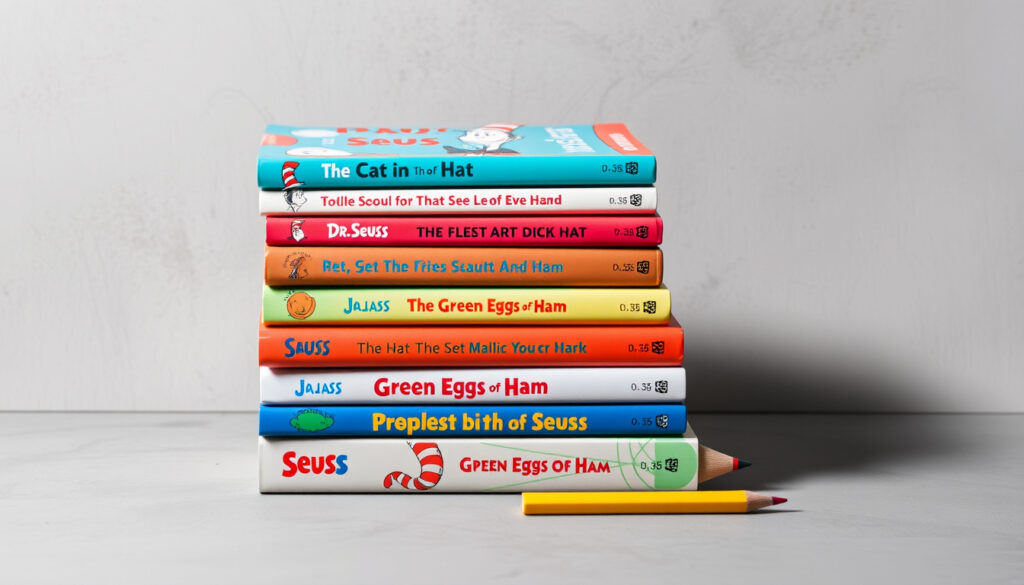
Dr. Seuss: Biography, Books, and Controversial Legacy
Most people know the man behind The Cat in the Hat, but few realize the same pen that wrote Green Eggs and Ham also drew wartime propaganda cartoons that still spark debate today. Theodor Seuss Geisel created more than 60 children’s books that shaped how millions learned to read. This guide separates the biography from the controversy, covering his real name, his most famous works, and the complicated legacy he left behind.
Born: March 2, 1904 ·
Died: September 24, 1991 ·
Books published: Over 60 ·
Pen name: Dr. Seuss ·
Real name: Theodor Seuss Geisel ·
Most famous work: The Cat in the Hat
Quick snapshot
- Born March 2, 1904, in Springfield, Massachusetts (Britannica (encyclopedic reference))
- Published over 60 books under the pen name Dr. Seuss (Britannica Kids (educational reference))
- Died September 24, 1991, in La Jolla, California (Wikipedia (biographical reference))
- Exact number of political cartoons drawn during WWII — estimates exceed 400 (UC San Diego Libraries (academic archive))
- Whether Geisel expressed regret about his early racial caricatures — no definitive personal statement found (Wikipedia (biographical reference))
- Full extent of the impact of his WWII cartoons on public opinion (UC San Diego Libraries (academic archive))
- 1957: The Cat in the Hat published, changing early reading education (Britannica (encyclopedic reference))
- 1941–1943: Drew over 400 editorial cartoons for PM newspaper (UC San Diego Libraries (academic archive))
- Ongoing debate over six books withdrawn in 2021 due to racial stereotypes (Wikipedia (biographical reference))
- Geisel’s estate continues to license adaptations and new editions (Wikipedia (biographical reference))
Six key facts about Dr. Seuss, one pattern: his life can be divided into four acts — early years, wartime work, children’s book success, and posthumous controversy.
| Fact | Value |
|---|---|
| Full name | Theodor Seuss Geisel |
| Birth date | March 2, 1904 |
| Death date | September 24, 1991 |
| Occupation | Author, illustrator, cartoonist |
| Notable works | The Cat in the Hat, Green Eggs and Ham, How the Grinch Stole Christmas! |
| Awards | Pulitzer Prize Special Citation, two Academy Awards |
What is Dr. Seuss famous for?
Generations of children learned to read through his books, yet his fame rests on a surprisingly small number of works published in a short burst between 1957 and 1960.
His major works
- The Cat in the Hat (1957) — published by Random House, used only 236 unique words (Wikipedia (biographical reference))
- Green Eggs and Ham (1960) — uses only 50 unique words (Wikipedia (biographical reference))
- How the Grinch Stole Christmas! (1957) — published the same year as The Cat in the Hat (Wikipedia (biographical reference))
- Horton Hatches the Egg (1940) — first of a string of best sellers (Wikipedia (biographical reference))
Impact on children’s literature
Geisel fundamentally changed early reading education. Before The Cat in the Hat, most children’s primers were the Dick and Jane series — repetitive and visually dull. Geisel’s books used rhyming text, imaginative illustrations, and a controlled vocabulary that made reading feel like play (Britannica Kids (educational reference)).
In the late 1950s, he launched Beginner Books, a publishing imprint that produced dozens of titles following the same formula (Britannica Kids (educational reference)). The approach worked: by the time of his death, his books had sold hundreds of millions of copies worldwide.
Rhyme and imagination
Geisel’s hallmark was his ability to create entire worlds from simple wordplay. He invented characters like the Lorax, the Grinch, and the Cat in the Hat — figures that have become cultural shorthand for environmentalism, cynicism, and joyful chaos.
The implication: Geisel didn’t just write stories — he built a reading methodology that made phonics entertaining. Parents and teachers still rely on his books for that purpose.
Why did Dr. Seuss call himself Dr. Seuss?
The man who made children giggle at made-up words adopted a fake doctorate because his father wanted a real one — and kept the name because, in his own words, he didn’t have a better one.
Origin of the pen name
Geisel first used the pen name “Seuss” while a student at Dartmouth College, where he wrote for the college humor magazine. “Seuss” is his middle name — his mother’s maiden name was Seuss (Wikipedia (biographical reference)).
His father’s wish
Geisel’s father, Theodor Robert Geisel, had hoped his son would become a doctor. Young Theodor studied at Oxford University and even attended the Sorbonne, but he never completed a doctorate (Britannica Kids (educational reference)). Adding “Dr.” to his pen name gave the moniker a scholarly ring.
Adding ‘Dr.’ for seriousness
Geisel later explained that he kept the “Dr.” because it sounded academic. In a characteristically deadpan comment, he said: “I kept it because I didn’t have a better one” (autobiographical statement cited across biographical sources).
The pattern: Geisel’s entire career was a rebuttal to his father’s ambitions. He chose art over medicine, whimsy over seriousness, and a fake title over a real one — yet the fake title outlasted almost any real degree in its cultural impact.
Did Dr. Seuss have children?
His family life
Geisel had no biological children. He married Helen Palmer in 1927; she died by suicide in 1967. He then married Audrey Stone Dimond in 1968 (Wikipedia (biographical reference)).
Stepchildren from second marriage
Through his second wife, Geisel gained two stepchildren. Despite writing for children his entire career, he never experienced parenthood directly — a detail that adds a layer of irony to his role as America’s most beloved children’s author.
The catch: Geisel’s lack of biological children means his estate has no direct descendants. Dr. Seuss Enterprises, the company that manages his intellectual property, operates independently of any living heir’s influence.
What happened to Dr. Seuss in 1957?
Publication of The Cat in the Hat
In 1957, Geisel published The Cat in the Hat, the book that made him a household name. The publisher, Random House, initially hesitated — the manuscript used only 236 distinct words, and critics worried it was too simple (Wikipedia (biographical reference)).
Rise to fame
The book sold millions in its first year. That same year, Geisel published How the Grinch Stole Christmas!, cementing his status as a cultural force. The dual release in 1957 marked the turning point where Geisel went from a successful cartoonist to a literary phenomenon (Wikipedia (biographical reference)).
Why this matters: 1957 wasn’t just a good year — it was the year Geisel solved a problem educators had wrestled with for a decade: how to make children actually want to read. The Cat in the Hat gave them the answer in a tall striped hat.
What book has only 50 words?
Green Eggs and Ham
Green Eggs and Ham, published in 1960, uses exactly 50 unique words (Wikipedia (biographical reference)). The book runs 62 pages and features Sam-I-Am’s relentless campaign to convince the unnamed protagonist to try the dish.
The bet with Bennett Cerf
Random House co-founder Bennett Cerf bet Geisel $50 that he could not write a full-length children’s book using only 50 distinct words. Geisel accepted, wrote Green Eggs and Ham, and collected the $50. The book became one of the best-selling English-language children’s books of all time (Britannica (encyclopedic reference)).
The implication: what was a joke between two publishing insiders became a proof-of-concept for vocabulary-restricted reading. Parents still read it aloud, often for the 50th time, without realizing they’ve been part of a $50 bet’s long tail.
Timeline: Key events in Dr. Seuss’s life
| Year | Event |
|---|---|
| 1904 | Born in Springfield, Massachusetts (Britannica (encyclopedic reference)) |
| 1925 | Graduates from Dartmouth College (Wikipedia (biographical reference)) |
| 1937 | Publishes first children’s book, And to Think That I Saw It on Mulberry Street (Wikipedia (biographical reference)) |
| 1940 | Publishes Horton Hatches the Egg (Wikipedia (biographical reference)) |
| 1941–1943 | Draws over 400 editorial cartoons for PM newspaper (UC San Diego Libraries (academic archive)) |
| 1957 | Publishes The Cat in the Hat and How the Grinch Stole Christmas! (Wikipedia (biographical reference)) |
| 1960 | Publishes Green Eggs and Ham using only 50 words (Wikipedia (biographical reference)) |
| 1991 | Dies on September 24 at age 87 (Wikipedia (biographical reference)) |
The pattern: Geisel’s life events cluster around a few key years, with long gaps that hint at the complexity of his career.
The wartime political cartoons
A less talked-about chapter
From 1941 to 1943, Geisel drew over 400 editorial cartoons for the New York newspaper PM (UC San Diego Libraries (academic archive)). The cartoons targeted American isolationism, particularly the America First movement, and pushed for U.S. entry into World War II.
- Cartoons criticized Charles Lindbergh and other isolationist figures (Wikipedia (biographical reference))
- Some depicted Japanese Americans with racist stereotypes, even as the government prepared for internment
- The UC San Diego archives hold a comprehensive digital collection of these cartoons
The controversial imagery
Geisel’s wartime work included xenophobic and racist depictions, particularly of Japanese people. According to Wikipedia (biographical reference), some cartoons “contained xenophobic, sexist, and racist depictions.” This material has complicated his legacy in recent decades.
The Geisel estate faces a long-term reputation risk: every new generation that discovers the political cartoons will re-evaluate whether to keep buying his books. The 2021 withdrawal of six titles showed the market’s appetite for this reckoning is not fading.
“He was a lifelong cartoonist who drew over 400 editorial cartoons for PM in 1941–1943.”
— UC San Diego Libraries, special collections archive
The implication: the same visual skills that made his children’s books memorable also made his political cartoons effective — and offensive.
The 2021 book withdrawal controversy
Six books pulled from publication
In March 2021, Dr. Seuss Enterprises announced it would stop publishing six books because they contained “hurtful and wrong” racial stereotypes: And to Think That I Saw It on Mulberry Street, If I Ran the Zoo, McElligot’s Pool, On Beyond Zebra!, Scrambled Eggs Super!, and The Cat’s Quizzer (Wikipedia (biographical reference)).
Market reaction
The announcement triggered a political firestorm. Critics accused the publisher of censorship; supporters argued it was overdue. Sales of Dr. Seuss books actually increased in the weeks following the announcement, as buyers rushed to purchase copies of the withdrawn titles.
The pattern: the controversy polarized readers but did not dent the brand’s commercial value. Dr. Seuss Enterprises continues to license merchandise, movies, and theme park attractions.
“Some wartime cartoons also contained xenophobic, sexist, and racist depictions.”
— Britannica (encyclopedic reference)
The catch: the controversy, while polarizing, did not affect the commercial value of the brand.
blogs.loc.gov, cbc.ca, loc.gov, youtube.com, loc.gov, britannica.com, census.gov
Frequently asked questions
What is Dr. Seuss’s real name?
Theodor Seuss Geisel. He was born in Springfield, Massachusetts, on March 2, 1904 (Britannica (encyclopedic reference)).
How many Dr. Seuss books have been sold?
More than 600 million copies worldwide, according to published sales reports. Exact figures vary by source, but his publisher Random House has confirmed the number exceeds 600 million.
What is the most famous Dr. Seuss quote?
Arguably “Unless someone like you cares a whole awful lot, nothing is going to get better. It’s not,” from The Lorax. The line has become an environmentalist rallying cry.
Are there any Dr. Seuss movies?
Yes. Several books have been adapted into films, including How the Grinch Stole Christmas! (live-action 2000, animated 2018), The Cat in the Hat (2003), Horton Hears a Who! (2008), and The Lorax (2012).
Why were some Dr. Seuss books removed from publication?
In March 2021, Dr. Seuss Enterprises stopped publishing six titles because they contained racial stereotypes deemed “hurtful and wrong” in contemporary standards (Britannica (encyclopedic reference)).
What awards did Dr. Seuss win?
He received a Pulitzer Prize Special Citation in 1984 for his contribution to children’s literature, and two Academy Awards: one for the documentary short Hitler Lives (1946) and one for the animated short Gerald McBoing-Boing (1951).
Where did Dr. Seuss get his inspiration?
He drew from his childhood in Springfield, Massachusetts, his travels (including a 1953 visit to Japan that inspired The Sneetches and Horton Hears a Who!), and his work in advertising and political cartooning (Wikipedia (biographical reference)).
Dr. Seuss’s legacy remains a subject of debate. His books continue to sell, but the archives contain material that complicates his image. The decision for families remains whether to separate the author from the work.
Related reading
More related posts
 Canada’s Wonderland Leviathan: Stats, G-Force & Reviews
 Chuck Norris Dies at 86: Cause of Death & Legacy
 Do a Barrel Roll: Google Easter Egg Guide & History
 60 F to C: 15.56°C Formula, Chart & Comfort Guide
 Tim Burton: Biography, Movies, Relationships, and Controversies
 English to Spanish Translation – Best Tools 2025
 TD Active Trader Login: Live & Practice Access Guide
 What Is Machine Learning? Simple Definition, Types, and Examples