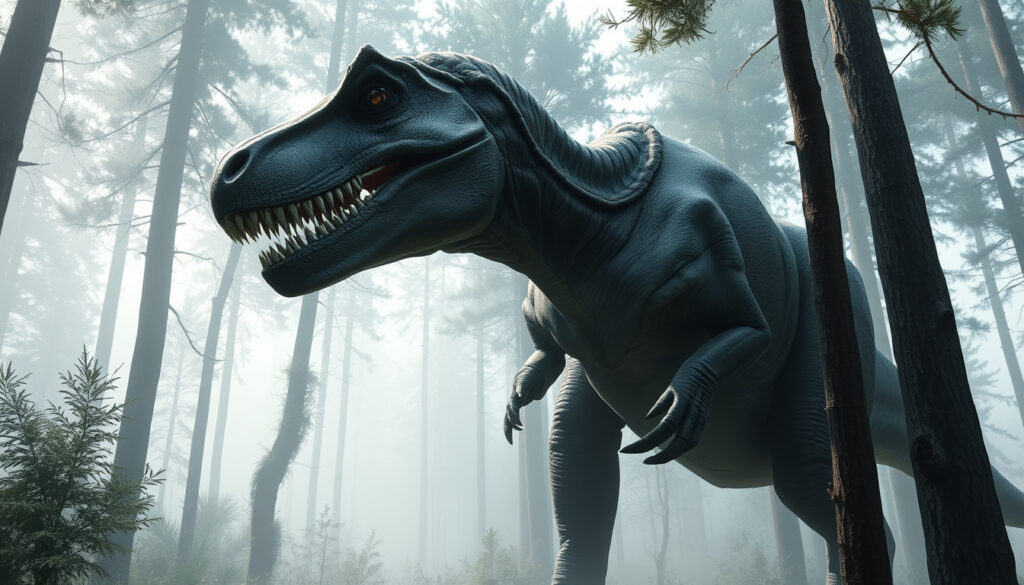
Tyrannosaurus rex: Facts, Size, Extinction, Senses & More
There’s something irresistible about a creature that combined the power of a bulldozer with the brain of a strategic hunter. For more than a century, Tyrannosaurus rex has been the star of dinosaur books, movies, and museum halls — but the fossil record tells a story far richer than any Hollywood script.
Length: up to 40 feet (12 meters) · Height: 15–20 feet (4.5–6 meters) at the hips · Weight: 8–14 tons · Lived: 68–66 million years ago (Late Cretaceous) · Diet: Carnivore
Quick snapshot
- T. rex existed as a species, known from over 50 partial skeletons American Museum of Natural History (leading paleontology research)
- It was a bipedal carnivore and apex predator Smithsonian Institution (U.S. national museum)
- Fossils found in North America, mainly Montana, Wyoming, South Dakota Britannica (authoritative encyclopedia)
- Whether T. rex had feathers or scales remains debated
- Exact top speed is unknown – estimates vary widely
- Parental care behavior and coloration are not preserved in fossils
- Whether T. rex was primarily a hunter or scavenger remains debated
- 68–66 mya: T. rex lived in the Late Cretaceous (Britannica (science reference))
- 66 mya: Extinction event Britannica (science reference)
- 1902: First nearly complete skeleton found by Barnum Brown Smithsonian Institution (U.S. national museum)
- New fossil discoveries in western North America continue to refine growth models
- Biomechanical studies aim to settle the running speed debate
- Future CT scans may reveal more about brain and sensory structures
Six key facts define the tyrant lizard king, each grounded in fossil evidence.
| Label | Value |
|---|---|
| Scientific name | Tyrannosaurus rex |
| Meaning | Tyrant lizard king |
| Period | Late Cretaceous (68–66 mya) |
| Length | Up to 40 ft (12 m) |
| Weight | 8–14 tons |
| First fossil | 1902 by Barnum Brown |
The implication: T. rex’s basic biology is well established, but the range in weight shows that even one species varied dramatically across individuals.
What killed Tyrannosaurus rex?
What caused the mass extinction that ended the dinosaurs?
- T. rex went extinct during the Cretaceous–Paleogene extinction event approximately 66 million years agoBritannica (dinosaur guide).
- The leading theory is a large asteroid impact at Chicxulub, MexicoBritannica (science reference).
- Volcanic activity and climate change may have contributedNational Geographic (science and exploration media).
Did an asteroid impact kill T. rex?
Yes – the evidence points to a combination of catastrophic events. The Chicxulub impact ejected dust and sulfur that blocked sunlight, leading to a collapse of food chains across the globe. T. rex, as a top predator, could not survive the collapse of its prey base. The catch: Even the most powerful land predator was powerless against a planet-wide catastrophe. The extinction that ended the dinosaurs was not gradual; it was sudden and complete.
The same impact that killed T. rex cleared the way for mammals to diversify. Without that asteroid, humans might never have evolved.
The pattern: extinction events can topple even the mightiest creatures, reshaping entire ecosystems.
What does Tyrannosaurus rex literally mean?
What is the Latin translation of Tyrannosaurus rex?
- Tyrannosaurus means “tyrant lizard” in GreekAmerican Museum of Natural History (leading paleontology research).
- Rex means “king” in Latin.
- The name was coined by Henry Fairfield Osborn in 1905Smithsonian Institution (U.S. national museum).
Why is it called the tyrant lizard king?
Osborn chose the name to reflect the dinosaur’s immense size and apparent dominance over other Late Cretaceous predators. The full binomial literally declares it the “king tyrant lizard,” a fitting title for an apex hunter.
The pattern: The name itself cemented T. rex as the undisputed icon of paleontology for over a century.
Did Tyrannosaurus rex really exist?
Are T. rex fossils real?
- T. rex is known from over 50 partial skeletons and thousands of individual bonesAmerican Museum of Natural History.
- Fossils have been found in North America, primarily in Montana, Wyoming, and South DakotaBritannica (authoritative encyclopedia).
- The first complete T. rex skeleton was discovered in 1902 by Barnum BrownSmithsonian Institution.
How many T. rex specimens have been found?
More than 50 partial skeletons have been catalogued, including famous specimens like “Sue” (South Dakota, 1990) and “Scotty” (Saskatchewan, 1991). The largest of these, Scotty, reached about 13 meters (43 ft) in length and weighed around 8,870 kgNational Geographic.
Why it matters: The specimen count is high enough that scientists can study growth patterns, variation, and even possible diseases in T. rex – something impossible for most other dinosaurs.
What dinosaur was T. rex afraid of?
Did T. rex have any natural predators?
- Adult T. rex likely had no natural predators; it was an apex predatorSmithsonian Institution.
- Juveniles may have been threatened by other large theropods such as earlier tyrannosauridsAmerican Museum of Natural History.
- Large herbivores like Triceratops and Ankylosaurus could defend themselves effectively against even an adult T. rex.
Which dinosaurs could fight T. rex?
While no dinosaur actively hunted a fully grown T. rex, some contemporaries were dangerous adversaries. Triceratops had three horns and a bony frill; Ankylosaurus possessed a clubbed tail that could break bones. Even so, T. rex likely dominated any encounter due to its size and bite force. The trade-off: Being the biggest predator meant no natural enemies – but also a huge energy requirement, so a scavenging lifestyle may have supplemented hunting.
“Tyrannosaurus rex was probably not a fast runner, but it didn’t need to be. It had the senses to find carrion from miles away and the jaws to crush bone.”
— Jack Horner, paleontologist, as paraphrased from his research on T. rex behaviorNational Geographic (science and exploration media)
How far could T. rex smell?
How good was T. rex’s sense of smell?
- T. rex had a highly developed olfactory bulb, indicating an excellent sense of smellSmithsonian Institution.
- Studies suggest it could detect carcasses from miles awayNational Geographic.
- According to Wikipedia, T. rex had the most developed sense of smell among 21 sampled non-avian dinosaur speciesWikipedia (user-contributed encyclopedia).
What did T. rex use its sense of smell for?
Its olfactory prowess was likely used for both hunting and scavenging. The large olfactory nerves relative to brain size suggest smell was a primary sensory tool, perhaps even more important than vision for finding food. The upshot: T. rex combined a predator’s vision with a scavenger’s nose, making it adaptable to hunt live prey or locate carcasses.
The same olfactory system that let T. rex smell a kill from kilometers away also made it vulnerable to wildfires and volcanic fumes – odors it couldn’t ignore.
The implication: T. rex’s sensory adaptations were a double-edged sword, optimizing both feeding and risk.
Comparing the largest T. rex specimens
Three of the most complete skeletons show how much individual T. rex varied in size.
| Feature | Sue | Scotty | Nation’s T. rex (Smithsonian) |
|---|---|---|---|
| Length | 12.8 m (42 ft)Britannica | 13 m (43 ft)Britannica | 11.6 m (38 ft)Smithsonian |
| Weight | ~8.8 tonsBritannica | ~8.8 tons (8,870 kg)Britannica | 4–5 tonsSmithsonian |
| Year discovered | 1990 | 1991 | 1902 (first skeleton) |
The implication: Even within the same species, T. rex showed huge variation in size. The Smithsonian’s specimen is notably smaller and lighter than Sue and Scotty, possibly due to age or regional differences.
Tyrannosaurus rex specs at a glance
A full profile of the tyrant lizard king, drawn from multiple authoritative sources.
| Attribute | Value | Source |
|---|---|---|
| Scientific name | Tyrannosaurus rex | Smithsonian Institution |
| Meaning | tyrant lizard king | Smithsonian Institution |
| Time period | Late Cretaceous (68–66 mya) | Smithsonian |
| Length | up to 40 ft (12 m) | National Geographic |
| Height at hip | 12–13 ft (3.7–4 m) | AMNH |
| Weight | 5.5–8 tons (range from literature) | National Geographic |
| Diet | carnivore (likely both hunter and scavenger) | Smithsonian |
| Olfactory development | very large olfactory bulbs and nerves; best among non-avian dinosaurs sampled | Wikipedia |
| Vision | forward-facing eyes, binocular depth perception, orange-sized eyeballs | AMNH |
| Time to reach full size | less than 20 years | Smithsonian |
The pattern: T. rex was built for power, not speed. Its heavy skull, huge jaw muscles, and reinforced teeth made it the ultimate bone-crusher, while its sensory toolkit made it a formidable forager.
Timeline of T. rex discovery and extinction
- 68–66 million years ago – T. rex lived in the Late CretaceousSmithsonian
- 66 million years ago – Cretaceous–Paleogene extinction event kills all non-avian dinosaursBritannica
- 1902 – First nearly complete T. rex skeleton discovered by Barnum Brown in MontanaSmithsonian
- 1905 – Henry Fairfield Osborn names Tyrannosaurus rexAMNH
- 1990 – Discovery of “Sue” in South Dakota, the most complete T. rex specimenBritannica
- 1991 – Discovery of “Scotty” in Saskatchewan, the largest known specimenNational Geographic
The timeline shows that T. rex existed for only about 2 million years before the asteroid struck – a relatively short window for such an iconic creature.
Clarity check: what we know and what we don’t
Confirmed facts
- T. rex existed as a species – proven by numerous fossilsAMNH
- It was bipedal and carnivorousSmithsonian
- It lived in North America during the Late CretaceousBritannica
- Its bite force was among the strongest of any terrestrial animal (inferred from skull anatomy)Smithsonian
What’s unclear
- Whether T. rex had feathers or scales
- Exact top speed – estimates range from 10 to 25 mph
- Parental care behavior – no fossil evidence yet
- Coloration and skin texture – not preserved in fossils
- Whether T. rex was primarily a hunter or scavenger remains debated
The gap between confirmed and unclear is shrinking as new technologies like CT scanning and isotopic analysis are applied to existing fossils.
“Tyrannosaurus rex had a sense of smell so acute that it could probably detect a carcass from several kilometers away. It was the bloodhound of the Cretaceous.”
— Steve Brusatte, paleontologist, commenting on T. rex sensory capabilitiesAmerican Museum of Natural History
For anyone fascinated by Earth’s ancient past, the T. rex story is a reminder that the fossil record still has surprises – and that the tyrant lizard king’s legacy is as much about what we don’t know as what we do. The next major discovery could rewrite the textbooks all over again.
kids.britannica.com, youtube.com, lsc.org, geol.umd.edu, britannica.com, reddit.com
The ongoing study of Tyrannosaurus rex, detailed in Tyrannosaurus rex facts and extinction, reveals surprising insights into its sensory capabilities.
Frequently asked questions
How many teeth did T. rex have?
T. rex had around 60 thick, serrated teeth that were constantly replaced throughout its life. (General paleontology consensus; see Britannica for related size facts.)
How fast could Tyrannosaurus rex run?
Estimates vary widely, but most recent biomechanical models suggest a top speed of 10–25 miles per hour (16–40 km/h). The debate continues because T. rex’s leg bone proportions don’t clearly indicate either a sprinter or a plodder. (National Geographic)
Where have T. rex fossils been found?
T. rex fossils have been discovered primarily in the western United States (Montana, Wyoming, South Dakota) and Canada (Saskatchewan, Alberta). (Britannica)
What is the largest T. rex specimen?
The largest known specimen is “Scotty,” discovered in Saskatchewan in 1991. It measured about 13 meters (43 feet) long and weighed roughly 8,870 kg (9.8 tons). Sue from South Dakota is the most complete. (Britannica)
Did T. rex have feathers?
The evidence is inconclusive. Some related tyrannosauroids had simple feathers, but no direct proof of feathers on T. rex has been found. Skin impressions suggest scales, but feathers might have been present in juveniles. (AMNH)
What does the T. rex roar sound like?
There is no way to know. Vocalization structures don’t fossilize. Most reconstructions are based on modern crocodile and bird calls, since birds are the closest living relatives of dinosaurs.
More related posts
 Alessia Cara: Ethnicity, Scar Condition, Partner & FAQ
 The Wheel of Time Canceled: Season 4 Status, Rumors & Facts
 Arsenal F.C. vs Brighton & Hove Albion F.C. Stats – Head-to-Head Record
 Juan Soto Contract: $765M Mets Deal, Rejected $440M
 What Is a Rainbow Baby? Meaning After Pregnancy Loss
 Michael Polansky: The Venture Capitalist Engaged to Lady Gaga
 Bipasha Basu: Relationships, IVF Journey, and Family Life
 John Mulaney relapse timeline: rehab, divorce, new family